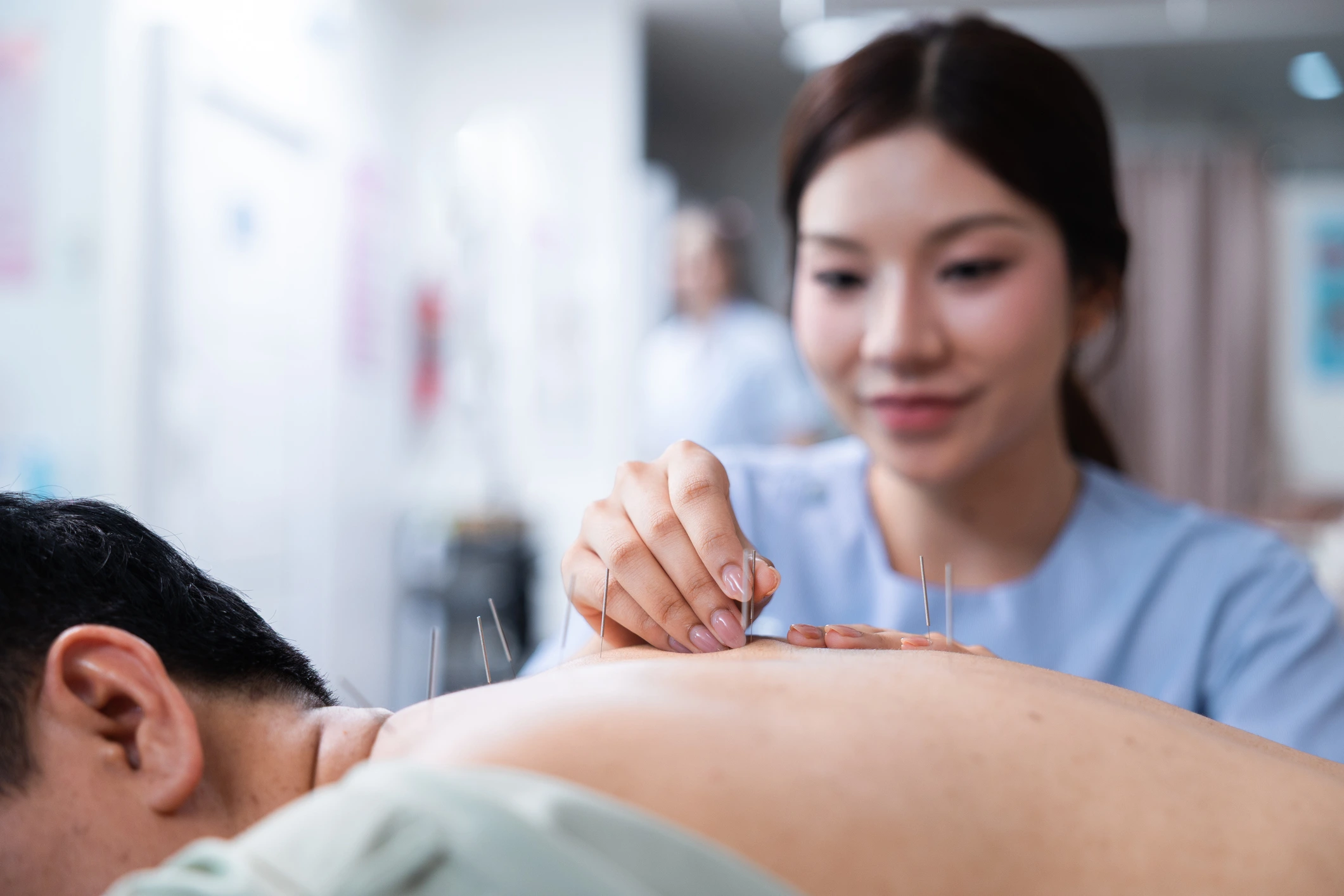
For many Chinese-speaking students, studying acupuncture involves more than learning point locations and needling techniques. It also means developing a detailed understanding of concepts such as Qi (气), Jingluo (经络), Yin and Yang (阴阳), Zangfu theory (脏腑) and pattern differentiation (辨证). Studying these concepts in Chinese may make the terminology easier to understand and connect with its Traditional Chinese Medicine roots.
You do not necessarily need to study overseas to receive acupuncture training in Chinese. At Vancouver Career College, we offer an Acupuncture Diploma in Burnaby with English-language and Chinese-language study options.
Here is what you should know about taking Chinese acupuncture courses in BC, including admission requirements, clinical training and the pathway toward becoming a registered acupuncturist.
Can You Study Acupuncture in Chinese in BC?
Yes. At Vancouver Career College, eligible students can complete our Acupuncture Diploma in either English or Chinese. You must provide proof of proficiency in the language of instruction you select.
Our Acupuncture Diploma includes:
- 96 weeks of training
- 1,920 total program hours
- In-class instruction
- Traditional Chinese Medicine courses
- Anatomy, physiology and biomedical science
- Acupuncture safety and treatment techniques
- Supervised clinical practice
- Preparation for the Pan-Canadian Acupuncturists Examination
Our Chinese graduates achieved a 94.70% Pan-Can Exam pass rate in October 2025.
Who May Benefit from a Chinese-Language Acupuncture Program?
Our Chinese-language acupuncture program may be a good option if you can speak, read and understand Chinese well enough to complete post-secondary healthcare training in the language.
You may benefit from studying in Chinese if you are:
- A newcomer who completed previous education in Chinese
- A Canadian resident educated in a Chinese-language school
- A mature student who understands technical concepts more easily in Chinese
- An internationally educated healthcare professional
- Interested in serving Mandarin-speaking or other Chinese-speaking clients
- Comfortable discussing TCM theory and terminology in Chinese
Acupuncturists in BC communicate with clients, maintain clinical records and work within a regulated healthcare environment. Being able to communicate in both Chinese and English may help you serve a broader range of clients.
Our program schedules and class availability may change, speak with our Admissions team to confirm the Chinese-language next intake and admission requirement. Our Admissions team can help you determine which documents are required for your application.
What Will You Study in Chinese Acupuncture Courses?
Professional acupuncture training involves much more than memorizing acupuncture points. You need to learn how to assess a client, develop a TCM diagnosis, select appropriate acupuncture points and provide treatment safely.
Our curriculum covers four major areas:
Traditional Chinese Medicine Foundations 中医基础理论
You will begin by studying the theories used to understand health and illness within Traditional Chinese Medicine (TCM).
Topics include:
- Yin and Yang
- Wu Xing, or the Five Phases
- Qi, blood, essence and body fluids
- Zangfu organ theory
- TCM etiology and pathogenesis
- The four TCM diagnostic methods
- Pattern differentiation
- Treatment and prevention principles
These subjects provide the theoretical foundation for later courses in diagnosis, treatment planning and acupuncture therapy.
Acupuncture Theory and Techniques 针灸理论与技术
Our acupuncture courses progress from meridian and point theory to advanced treatment techniques.
You will study areas such as:
- Jingluo, or channels and collaterals
- Acupuncture-point locations
- Point functions and clinical applications
- Needling techniques
- Moxibustion
- Cupping
- Gua sha
- Scalp acupuncture
- Auricular acupuncture
- Electro-acupuncture theory
- Treatment principles
- Acupuncture-point prescriptions
- Clinical case studies
The curriculum also introduces TCM Tuina, dietary therapy and selected herbology subjects.
Biomedical Sciences 生物医学科学
Although the program is grounded in TCM, you will also study the human body from a biomedical perspective.
Biomedical subjects include:
- Human anatomy and physiology
- Musculoskeletal anatomy
- Microbiology
- Pharmacology
- Pathology
- Medical tests and diagnosis
- Infection prevention and control
Our program combines TCM philosophy, meridians and acupoints with physiology, anatomy, microbiology and Western medical diagnosis.
This combination helps you understand both traditional treatment concepts and the safety considerations involved in modern healthcare practice.
Professional Practice and Safety 专业实践与安全
You will also study the professional responsibilities involved in working as an acupuncturist.
Topics include:
- Patient counselling
- Professional communication
- Ethics and boundaries
- Clinical recordkeeping
- Practice management
- Clean needle techniques
- Infection control
- Risk management
- Regulatory requirements
These areas are essential because acupuncture is a regulated health profession in British Columbia.
Does the Acupuncture Diploma Program Include Clinical Training?
Yes. Clinical practice (临床培训) is a major part of our Acupuncture Diploma program.
You will begin with an introductory clinical practice course. In a simulated clinical environment, you will practise:
- Patient assessment
- TCM diagnosis
- Clinical recordkeeping
- Treatment procedures
- Safety measures
- Professional communication
You will work with classmates under the direct supervision of an instructor before progressing to patient care.
Later in the program, you will complete several supervised clinical practice courses. You will begin seeing patients, discussing possible diagnoses and providing acupuncture or TCM treatment under the supervision of a clinic instructor.
Our curriculum includes 460 hours of supervised clinical practice. This hands-on training allows you to apply classroom knowledge while developing your assessment, communication, and treatment skills.
Can You Take the Pan-Canadian Acupuncture Examination in Chinese?
Yes, the Pan-Canadian Examinations may be offered in Simplified Chinese and Traditional Chinese in British Columbia. However, Chinese-language availability depends on the specific examination administration.
In BC, candidates must apply through the College of Complementary Health Professionals of British Columbia (CCHPBC) and receive approval before booking the examination. When preparing to register, confirm whether Simplified or Traditional Chinese is available for your selected examination date.
Keep in mind that examination-centre proctors communicate in English and may not speak Mandarin or Cantonese. Candidates who require additional language support should contact CCHPBC before examination day.
Bonus Read: What Is the Pan-Canadian Examination for TCM and Acupuncture in BC?
Does Completing the Diploma Make You a Registered Acupuncturist?
No. Completing our Acupuncture Diploma is an educational step toward the profession, but graduation does not automatically give you the right to use the Registered Acupuncturist, or R.Ac., title.
Applicants must meet the registration requirements established by CCHPBC. These currently include completing recognized acupuncture education and at least two years, or 60 credits, of qualifying liberal arts or sciences study.
The same courses generally cannot be used to meet both the acupuncture education requirement and the separate 60-credit requirement.
Applicants may also need to complete:
- The Pan-Canadian Acupuncturists Examination
- The CCHPBC TCMA Jurisprudence Examination
- The CCHPBC Interactive Safety Course
- A criminal record check
- Other current application and registration requirements
Review the latest CCHPBC registration requirements before beginning your training. This is particularly important if you have not already completed the required liberal arts or sciences credits.
Start Your Acupuncture Training in BC
You do not have to leave Canada to pursue structured acupuncture training in Chinese. At Vancouver Career College, our Acupuncture Diploma combines Traditional Chinese Medicine theory, acupuncture techniques, biomedical sciences and supervised clinical experience at our Burnaby campus.
Before applying, confirm the availability of the next Chinese-language intake, review the proficiency requirements and understand the full CCHPBC registration pathway.
Explore our Acupuncture Diploma Program in Burnaby and speak with our Admissions team about studying acupuncture in Chinese in BC.
如果您希望在卑诗省(BC)以中文学习针灸,Vancouver Career College 的针灸文凭课程可让符合中文语言要求的学生接受系统化培训。课程涵盖中医理论、针灸技术、生物医学知识及临床实习,并为后续参加针灸师考试及申请卑诗省注册资格打下基础。申请前,请确认中文班的开课时间、入学语言要求,以及 CCHPBC 最新的注册规定。