



In this panel, you can manage your personal information preferences. Some cookies are essential for basic website functionality and cannot be customized, but you can disable others. You can update your choices at anytime through the provided link. Adjust the toggles below to deny consent for specific processing activities, or use the 'Reject All' button.

Train to Become An Education Assistant
Learn to support students with diverse learning needs in inclusive environments. Gain hands-on experience to step confidently into the field.
Increase Your Income Potential
The BC median wage for an EA is $30/hr. Jobbank.gc.ca, 2026.
Scholarship
Up to $4,000 available for eligible students, until September 30, 2026. Terms apply.
Campus Availability
Surrey
High Employment Rate
Over 84% of our graduates have found employment within their field.
Program Overview
Education Assistant Diploma
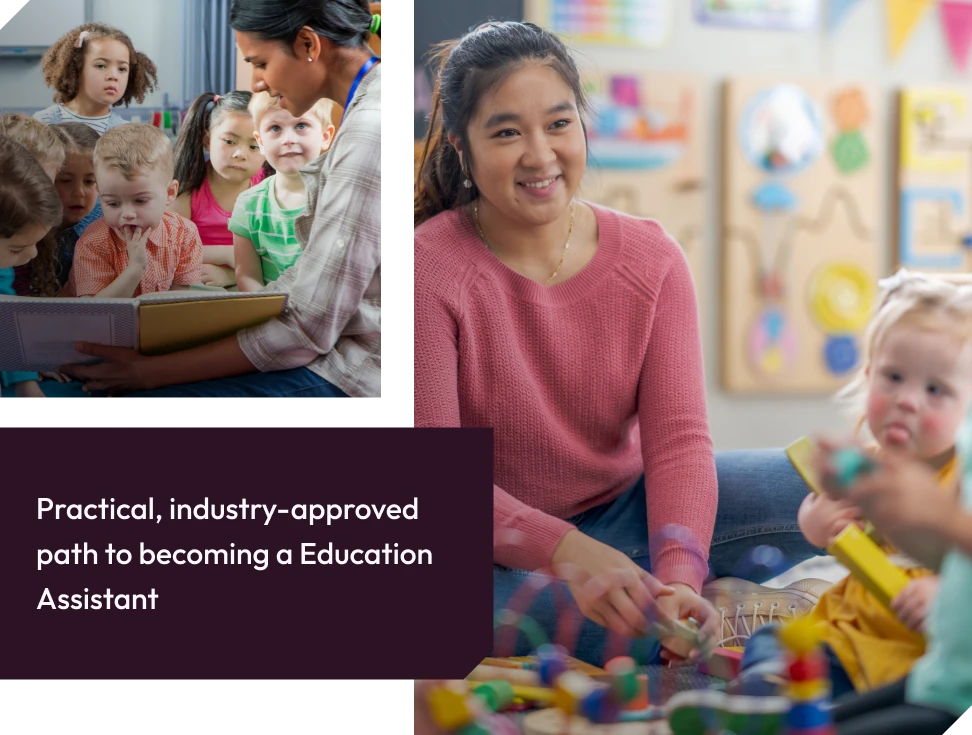
Vancouver Career College’s Education Assistant program prepares you to play a meaningful role in supporting children and youth with diverse learning needs across early childhood, elementary, and secondary school settings.
In just 43 weeks, you’ll gain hands-on, job-ready training through specialized coursework in autism support, behavioural strategies, mental health, and inclusive education combined with real-world practicum experience. You’ll graduate with the skills and confidence to support student learning, assist educators in the classroom, and help create safe, inclusive environments where every student can succeed.
During the program, you may also complete additional industry-recognized certifications, including:
-
Standard First Aid with CPR ‘C’ and AED
-
Nonviolent Crisis Intervention Foundation course
-
Applied Suicide Intervention Skills Training (ASIST)
-
WHMIS
Recognition
Training that meets industry and regulatory standards
Our programs are designed to meet established industry and provincial requirements, helping ensure your education is respected by employers and aligned with current workforce expectations. This commitment reflects our focus on quality training, accountability, and career-ready outcomes.
Program is approved by the Registrar of the Provincial Training Institutions Regulatory Unit (PTIRU)
Program Requirements
Speak With Admissions
Admission & Requirements
Admissions advisors will guide you through each step
-
Proof of high school graduation or equivalent (General Education Development or BC Adult Basic Education)*
OR
Mature student status (19 years of age upon starting classes and must pass the College’s General Math Exam with a passing score of 50%)
AND
-
Proof of English Language proficiency
*Note: Transcripts from an institution outside of Canada must be verified by an international education credential evaluation service, such as WES or ICES.
Practicum, Clinical Placement or Preceptorship Requirements
-
Criminal record check (in accordance with the Criminal Records Review Act)
-
Up-to-date immunization report (form provided by college)
Making Your Education Accessible
Financing your educational journey shouldn't hold you back. At Vancouver Career College, our dedicated team of Student Financial Planners is available to guide you through available financial options, depending on what you may qualify for.
Potential Funding Options
Government Student Loans: Government of BC-sponsored loan assistance for eligible students.
Student Lines of Credit: Offered through financial institutions, allowing you to borrow as needed.
Grants, Bursaries and Agency Funding: You may qualify through federal or provincial retraining programs, including WorkSafeBC and other government agencies.
Personalized Financial Support: Your Student Financial Planner will help you explore potential funding sources and identify options based on your situation.
Scholarships
We've awarded over $1 million in scholarships to students across all backgrounds. Talk to your campus Student Financial Planner to find out what you may qualify for.
-
Successful completion of all on-campus courses with a 70% overall average.
-
Successful completion of both practicum components.
-
Successful completion of term projects/assignments.
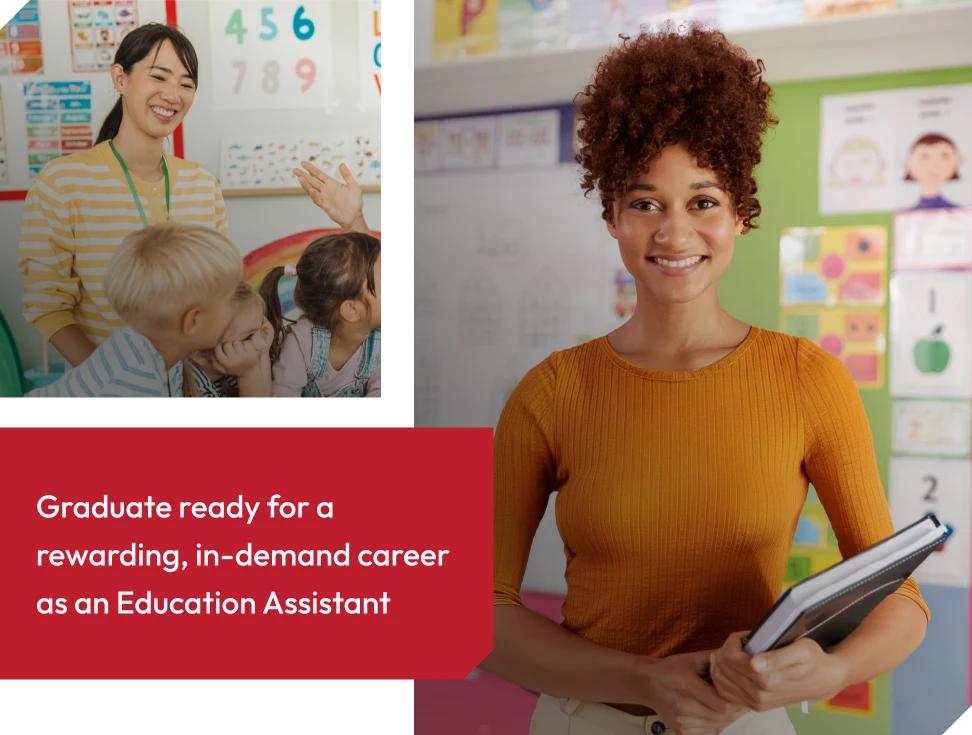
Career Paths for Education Assistant
Step into a meaningful career supporting children and youth in schools and community settings across BC. As an Education Assistant, you can work alongside teachers and support students with diverse learning needs in classrooms, specialized programs, and inclusive learning environments.
- Elementary schools
- Secondary schools
- Early childhood education settings
- Youth centres
- Recreation programs
- Home/community support
- Group homes
- Family service centres
Find market-ready opportunities with guidance from Career Services.
What You'll Learn
Graduate With Practical Skills
Build the skills to support students with diverse learning needs - from autism and behavioural support to communication, life skills, and mental health - through training designed for real classroom and community settings.
Education Assistant - Program Courses
This course equips students with the knowledge, skills, and study strategies needed to support effective learning and a positive educational experience. It explores learning theories and their application to individual study methods, helping students develop approaches that are both effective and efficient. Key topics include study habits, note-taking, goal setting, values, time management, task prioritization, and stress management through learner-centered activities. The course also introduces fundamental concepts of Artificial Intelligence (AI), including its applications, limitations, and ethical, social, and moral implications. In addition, students will start a series of financial training modules to develop financial literacy skills related to budgeting, saving, credit, and debt and gain practical money management skills to effectively manage their financial well-being.
Students will analyze their own educational beliefs and how those beliefs will assist them within their role as an educational assistant. Students will explore and expand their knowledge of the provincial and school boards philosophies and how their role is best utilized to support the children. Students will also be introduced to individual
educational plans and how these plans support the child. The purpose of this module is to assist students with the understanding of the role of the educational assistant within the school board system and how they can best support children and community. Emphasis will focus on a variety of learning styles and how individual educational plans can best support learning outcomes.
Pre-requisite: EA100
The purpose of this course is to provide students with a better understanding of how an inclusive environments foster healthy learners within the Canadian school system. Students examine different ways to include children of all needs and abilities in a classroom and are provided with strategies to foster inclusion by individualizing learning for each student, regardless of their exceptionality. They explore fundamental background knowledge in the field of special education. Topics include an introduction to the
individual education plan, students with various learning challenges, and equity and diversity. The course also provides an introduction to the Universal Design for Learning (UDL), which addresses the support of students with diverse learning needs.
How does a teacher learn to be outstanding? One key pathway is to learn the science of child development and know how to apply it in the classroom. This provides teachers (and education assistants) with a solid foundation from which to problem solve how to best educate each student. To be successful, one must understand each student as a learning, feeling, relating human being. The goal of this course is to help participants create classrooms that optimize students’ development.
Using case studies, research, and reflections on practice, students gain a solid foundation in developmental psychology as well as practical skills for applying that knowledge in a classroom. The course emphasizes diversity – individual and group –age trends, and classroom implications, along with sections on the foundations of child development, the cognitive child, the emotional child, the social child, and the whole child.
This course will address human development from conception through adolescence, with a focus on childhood to teenage years. Students will learn about fetal development and the effect of teratogens on an unborn child. There will be in depth review of a child’s social, emotional, physical, cognitive and cultural development. Students will study psychological theories and how they relate to child development.
Students are introduced to the basic concepts and methods related to studying communication, covering both typical speech and language development along with information on disordered speech and language. Foundational science is covered (the anatomy and physiology of speech, language, and voice production) as well as articulation and phonology and related disorders. Language development in children and the related disorders are also studied, including communication in a multicultural society and its characteristics and these speech/language differences versus disorders. Speech and language disorders in adults – neurological impairment – are also discussed.
Other subjects in this course cover various impairments and conditions: voice disorders; swallowing disorders; fluency disorders; the anatomy and physiology of hearing and hearing disorders; and hearing testing and management of hearing disorders. During this course, students are also introduced to American Sign Language (ASL) where they begin to learn basic vocabulary development, the manual alphabet, simple structures, and grammatical forms of ASL, history, finger spelling, numbers, terminology, and insight into the culture and community of deaf people. After this ASL introduction, students are assigned an ongoing training assignment following the Signing Naturally curriculum where students aim to reach a fundamental competency in signing by following multimedia exercises, home study and practice, and intermittent role playing and communication labs with their classmates. Later in the program, students will apply what they have learned into a term project where they learn to use ASL in the classroom.
Why Choose This Program
Why Students Choose Our Education Assistant Program
Built for outcomes, not just credentials
From your first class to your final practicum, the focus is on building hands-on, job-ready skills. Learn from experienced instructors, apply your training in real classroom settings, and graduate prepared to support students and educators with confidence.
- Approved program
- Two supervised practicums (8 weeks total) in real classroom settings
- Specialized training in autism support, behaviour strategies, and mental health
- Opportunity to earn additional industry-recognized certifications
- Career and employment support for up to six months after graduation
Still have questions? Book a campus visit and talk with our Admissions team.
I had a great experience with the Education Assistant program. The instructors were knowledgeable, supportive, and genuinely interested in helping students to succeed.
I would like to thank the college for offering a valuable Education Assistant program. I learned many important skills, and the course was very helpful overall.
Cooperative and understandable staff. Good education. I had a good experience during my course.
Frequently Asked Questions
Education Assistant Program FAQs

Vancouver Career College is approved by the Private Training Institutions Regulatory Unit (PTIRU) of the Ministry of Post-Secondary Education and Future Skills. For more information, visit the PTIRU site here.
Our campuses offer a variety of start dates, in some cases, every two weeks. To learn more about our upcoming start dates, please reach out to your campus of choice HERE
Our experienced Student Financial Planners can provide further details on program funding. Refer to the Financial Options webpage for more information.
Programs may be available in a variety of modalities. Please refer to the specific program page to learn more. If you have additional questions about learning online, please click HERE to learn more about admissions.
You can find our tuition listed HERE.
The length of this program is listed in the Program Overview section on this page. Have questions? Click here to connect with an Admissions Advisor.
Start Your Career in Education Assistant
For over 30 years, Vancouver Career College has delivered trusted career training. Explore how our programs can support your goals. Connect with an advisor today.
Get Started