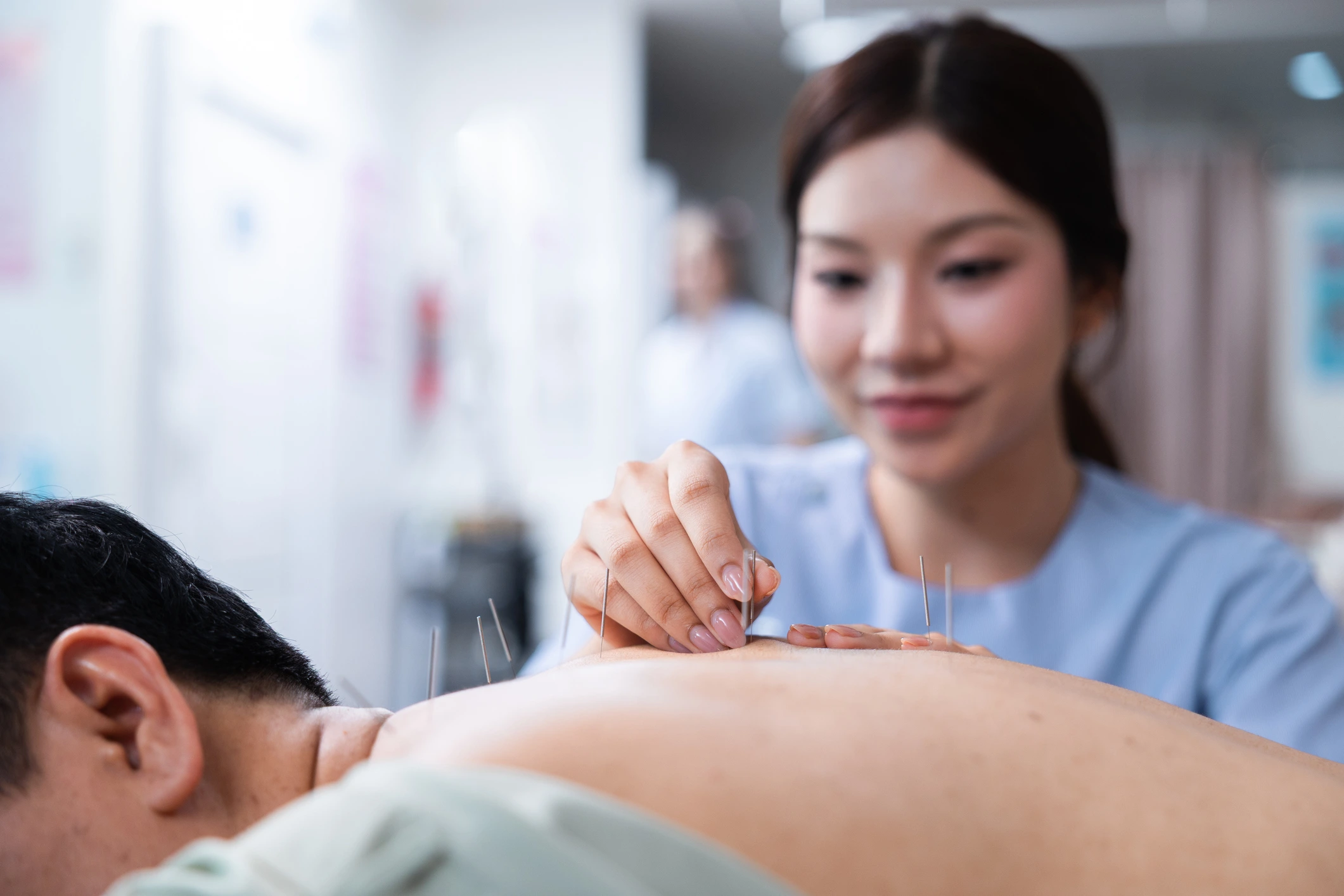
If you're changing careers and your last science class was in high school, anatomy can look like the riskiest part of becoming a registered massage therapist (RMT). It's a heavy workload, but it's taught from the basics, and the hardest stretch is predictable enough to plan around.
This guide shows where anatomy sits in Vancouver Career College's (VACC) Registered Massage Therapy program, how the licence exam uses it and a weekly study system grounded in learning research.
How Hard Is Massage Therapy Schooling?
Massage therapy schooling is hard mainly because of volume and pace, not because it expects a science background. At VACC, anatomy, physiology and neurology courses make up 660 of the program's 2,751 hours, and you need at least 70% in every course to graduate.
For most career changers, the challenge comes from four places:
- New vocabulary: each muscle comes with an origin, an insertion, an action and a nerve supply to learn
- A front-loaded schedule: most of the anatomy arrives in your first two terms
- Learning by touch: you learn to find each structure with your hands, not just name it
- A minimum in every course: the 70% mark applies to each course and to all final practical and theory exams
Do You Need a Science Background For RMT School?
No. VACC's RMT admission requirements are high school graduation or equivalent (or mature student status at 19), English proficiency, the Introduction to Massage Workshop and an interview, and none of them asks for a specific biology or chemistry course.
The program also starts at the beginning. Anatomy and Physiology I opens with how the body is organized (planes, quadrants and cavities), then moves through cells, tissues and organ systems. So the real question for a career changer isn't whether you took biology. It's whether you can protect steady study time from week one.
Where the Anatomy Load Sits Across the Eight Terms
By our count of VACC's course hours, two-thirds of the anatomy, physiology and neurology hours (444 of 660) fall in Terms 1 and 2, before supervised clinic shifts begin in Term 3. Course order within a term can vary:
| Term | Anatomy, physiology and neurology courses | Anatomy hours | Share of the term |
|---|---|---|---|
| 1 | Upper body and trunk anatomy, upper body palpation, Anatomy and Physiology I | 242 of 352 | 69% |
| 2 | Lower body anatomy and palpation, Anatomy and Physiology II, peripheral nervous system, arthrology (joints) | 202 of 350.5 | 58% |
| 3 and 4 | Anatomy and Physiology III, central nervous system I and II | 99 of 680.5 | 15% |
| 5 and 6 | No stand-alone anatomy courses; anatomy is applied in orthopaedic and neurological treatment | 0 of 708 | 0% |
| 7 and 8 | Anatomy and Physiology Review I and II, MSAK Consolidation | 117 of 561 | 21% |
What this means: the steepest climb comes while you're still getting used to being a student again. If you have kids, Terms 1 and 2 are the time to lock in reliable child care and keep extra work shifts to a minimum. Terms 5 and 6 then ask you to use that anatomy to treat conditions region by region, so gaps from early terms can surface there.
How the Licence Exam Tests Anatomy
The College of Complementary Health Professionals of BC (CCHPBC) tests anatomy through application and touch, not recall alone. Its exam components guide says Clinical Knowledge and Theory (CKT) questions are written at a "comprehend" or "analysis" level, and its CKT blueprint (updated September 2023) weights assessment at 60% to 70% of the exam:
| Exam part | How anatomy shows up |
|---|---|
| CKT exam | 150 multiple-choice questions, standalone or case-based, that ask you to apply anatomy to assessment and treatment decisions |
| Performance-based assessment, Part 1 | 15 minutes to palpate the origin, course and insertion of four muscles, demonstrate all their actions and complete a muscle test for each, then five minutes to identify or palpate four more structures |
In practice, the palpation courses that start in Term 1 rehearse the same skill the performance-based assessment tests. Our guide to the CCHPBC exam covers every component, and our RMT exam study tips cover the months before you sit it.
A Weekly Anatomy Study System for Adults Returning to School
Self-testing and spaced review have the strongest research support. A 2013 review of 10 study techniques rated practice testing and distributed practice as high utility, and rereading and highlighting as low utility.
| Habit | What it looks like in RMT school |
|---|---|
| Quiz yourself instead of rereading | Put a muscle on the front of a card and its origin, insertion, action and nerve supply on the back, then answer before you flip |
| Space your reviews | Spread short sessions across the week instead of one long one, and keep Term 1 cards in rotation during Term 2 |
| Decode the word parts | MedlinePlus lists roots such as brachi (arm), carp (wrist) and cost (rib), which help explain names like brachioradialis, flexor carpi radialis and intercostals |
| Find it by touch | After learning a landmark, locate it on yourself, then rehearse it in lab using landmarks, visualization and an isometric (held) contraction |
| Explain it out loud | Tell a classmate or family member why a muscle creates its movement; the same review rated self-explanation as moderate utility |
| File notes by body region | Organize notes by region (shoulder, elbow, lower back), the way later orthopaedic treatment courses are organized |
For career changers: 10 minutes of cards in the school pickup line or on transit still counts as a spaced session.
Signs You're Falling Behind in Anatomy
Catching a gap early matters because every course needs 70%. Watch for these signs:
- You recognize answers when rereading notes but can't produce them from a blank page
- You can name a muscle but can't find it by touch
- Term 1 structures feel unfamiliar again by mid-Term 2
- Most of your studying happens the night before a test
If these sound familiar, talk to your instructor early rather than waiting for a final exam.
How to Get a Head Start Before Term 1
You don't need a science course before you start, but a few weeks of preparation can make Term 1 feel less foreign:
- Learn body planes, quadrants and cavities, which open Anatomy and Physiology I
- Preview the bones and landmarks of the upper body and trunk, where Term 1 anatomy begins
- Run a two-week flashcard trial to see where study time fits in your family routine
- Book a treatment at a VACC student clinic to see what clinic training looks like up close
Start with a System, Not a Science Degree
You don't need a science background to start RMT schooling at Vancouver Career Coolege, but you do need a plan for Terms 1 and 2, where most of the anatomy lands. A self-testing routine built before your first class is a practical way to prepare for the hardest stretch.
Request more information about Vancouver Career College's Registered Massage Therapy program, admission requirements, financial options and start dates.